Featured

There is no One Size Fits All Treatment

***TRIGGER WARNING***

Mental health is complicated. Our brains are genetically wired, but also wired by our experiences. Our brains are influenced by what we eat, what we watch, the people we surround ourselves with and what we choose to focus on. So, when it comes to treating a mental health disorder, it may take a lot of trial and error to figure out what works best for you. On top of that, hopefully you are working with a doctor that truly listens and cares about your well-being. Take into account that there is typically no overnight relief or quick fix. It took time for your brain to be conditioned, so it will take time for you to heal. Be patient with yourself.

This next paragraph my trigger you, so please proceed with caution. I know mental health is a disease. I have seen it day in and day out in my profession. As a human who struggles and has severely struggled in the past though, it is hard for me sometimes to tell people, “This will go away forever” because I don’t truly believe it does. To me, it’s about learning how to manage it when those demons rear their nasty heads and voices back into your mind. But you have to find what works best for you and have faith (even though you feel hopeless and lost) that things will get better. I think that is the hardest thing to do. Last time I traveled to Ohio, I asked my mom about a longtime friend they had. She told me he wasn’t doing well because his daughter recently died by suicide. My heart immediately sank. She proceeded to tell me that their daughter had been struggling with alcoholism. She lost her family because of it. She decided she couldn’t struggle anymore and took her life. Her father (my parent’s dear friend for years who is a doctor) found her and tried to revive her, as her body was still warm. He was unsuccessful. Hearing this story affected me for a while. How can we reach people going through that? How can we educate them about their options? How can we give hope to those individuals? There is no one way to heal someone.

Last month, I got a call that one of my friend’s was killed by a red-light runner. I had just recently connected with this person and our connection was deep. This friend was more of a soul connection. It is hard for me to even think about her as she was just waking up from her depression and anxiety. The last time I talked to her, she was on a spiritual journey and truly finding herself. It was a beautiful thing. She had a brilliant mind and had tried various treatments. What worked the best for her was microdosing psilocybin. It brought her out of her anxiety and allowed her to live again. Then her life was taken suddenly. I am grateful she got to feel joy and happiness before she was taken from us, but my heart also aches because I can’t physically be in her beautiful presence anymore.

So, what am I getting at here? Don’t be scared to try new forms of treatment that may seem unconventional. Be careful with your brain. Protect it. Reach out to people. Understand things are not easy but try to have some faith. Whatever kind of faith that gets you through. There are people out there that care and will help you. Even perfect strangers.
Featured

Hi, I AM depressed!!

One of the most common things I heard from patients and see on social media is the phrase, “I am depressed” or “I have always been a depressed person!” It’s like suffering from depression becomes a part of peoples’ identities and they use that as a trait to describe their personality. Here is something to think about, we are trying to abolish the stigma of mental health, but it is somewhat difficult if people start using depression as a crutch or making it a part of who they are. Mental health takes work and awareness. I have seen very many different types of depression. I have been depressed. I too, even suffer from suicidal ideations from time to time, and I have since I was 8 years old. What I don’t hear or see is people who are diagnosed with cancer saying, “I AM cancer.” You typically hear, “I have cancer” or “I was diagnosed with cancer.” Why am I writing about this? Because our brains listen and believe the things we say! Read this article by Psychologist Dr. Mahoney (2018): http://drdianemahoney.com/your-brain-believes-everything-that-you-say/

So, how can we fix this or help ourselves? The brilliant Psychologist Susan David (who I have mentioned quite a few times) talks about this in her TED talk and book (please see my resources section for the talk and book). One of the things we need to understand as humans is, we are NOT perfect, and life isn’t always going to be sunshine and unicorns. Sometimes we have days, weeks or even months when life sucks and you might feel hopeless. I try (when I say I try, I am my own worst enemy and fail a lot) to see my depression and anxiety as making me stronger or even going back to reactive gratitude. When you go through a difficult period and finally come out of it, life seems so much brighter and more fulfilling. Like my one of my favorite cheesy quotes, “Not all storms come to disrupt your life, some come to clear your path” (Author Unknown). So, when you’re going through a shitty time, try to think about it as character building or life preparing you to handle more because you’re a badass!

Featured

Can I change my Genetics? Yes…well, somewhat!

I cannot tell you how many times I would hear a patient come in saying that their sister, mother, father or brother were depressed and/or suicidal. “It runs in my family!” The last statistic I read, stated that depression is about 40-50% genetic, however other research has shown that epigenetic and other environmental factors play a big role in the development of depression (Lin & Tsai, 2019). What does this mean??? Do you have the ability to change your genetics? According to epigenetics, yes you do. Epigenetics is defined as “the study of how your behaviors and environment can cause changes that affect the way our genes work” (What is Epigenetics, 2020, para. 1). For more of a real-life example, let’s say depression runs in your family, but you are very cognizant of this. So, you take measures in your life to manage your physical health, as well as your mental health like: working out, meditating, eating right, monitoring what you choose to watch/look at and (when you can) who you choose to surround yourself with. Does this mean you will never experience depression? No, but you have worked hard in educating yourself , which may help you mitigate your symptoms. “Epigenetic processes are particularly important in early life when cells are first receiving instructions that will dictate their future development and specialization. These processes can also be initiated or disrupted by environmental factors, such as diet, stress, aging and pollutants” (Epigenetics, 2021, para. 8). Being educated about epigenetics, especially at a younger age, would be very difficult. That is why I think it would be so beneficial for our youth to understand how to take care of their mental health, just like they understand brushing their teeth is good for their physical health. I truly believe we will get there one day.

Below are some great articles, one funny Youtube video and of course a TED talk explaining Epigenetics! I hope this enlightens you as much as it did me!

Epigenetics. (2021, November 16). National Institute of Environmental Health Services. Retrieved May 10, 2022, from https://www.niehs.nih.gov/health/topics/science/epigenetics/index.cfm?msclkid=c46c649dd06411ecbc114227b68000be

Lin, E., Tsai, L. (2019). Epigenetics and Depression: An Update. Psychiatry Investigation, 16(9), 654–661. https://doi.org/10.30773/pi.2019.07.17.2

What is Epigenetics? (2020, August 30). CDC. Retrieved May 10, 2022, from https://www.cdc.gov/genomics/disease/epigenetics.htm?msclkid=87372a08d0a111ec8d13b2b351e19b47

Featured

You CAN teach an Old Dog New Tricks!

What has been discovered about the brain in the last 10 years is astounding. I know I haven’t even scratched the surface of it. It seems like we can throw out the principles that we use to believe and adapt new ones. On the intro page I mention that Neurogenesis is something that can help us, especially in mental health. The myth was, that once you lost neurons in the brain, they were gone forever, and we didn’t produce any more. Guess what??? That’s not true! Scientists discovered that we could produce new neurons. The hippocampus, the part of our brain responsible for long-term memory, can produce 700-1500 new neurons each day (Solan, 2021). This process also supports existing neurons. So how does this help YOU with your brain and your mental health??? Scientists also found that reoccurring bouts of depression led to shrinkage in the hippocampus (How Depression Changes your Brain, 2016). So, learning how to produce neurogenesis in the brain could help restore and generate those connections for depressed individuals or serve as a preventative measure for those individuals who may be prone to depression. But, how do you generate neurogenesis in your own brain? Do something you have never done before and learn a new concept for your brain. Maybe you just did! Also, watch this!!!
You can grow new brain cells. Here’s how | Sandrine Thuret
https://youtu.be/B_tjKYvEziI


How Depression Changes your Brain. (2016, August, 8). https://www.powerofpositivity.com/depression-changes-brain-ways-reverse/

Solan, M. (2021, August, 1). The Book of Neurogenesis. https://www.health.harvard.edu/mind-and-mood/the-book-of-neurogenesis

Featured

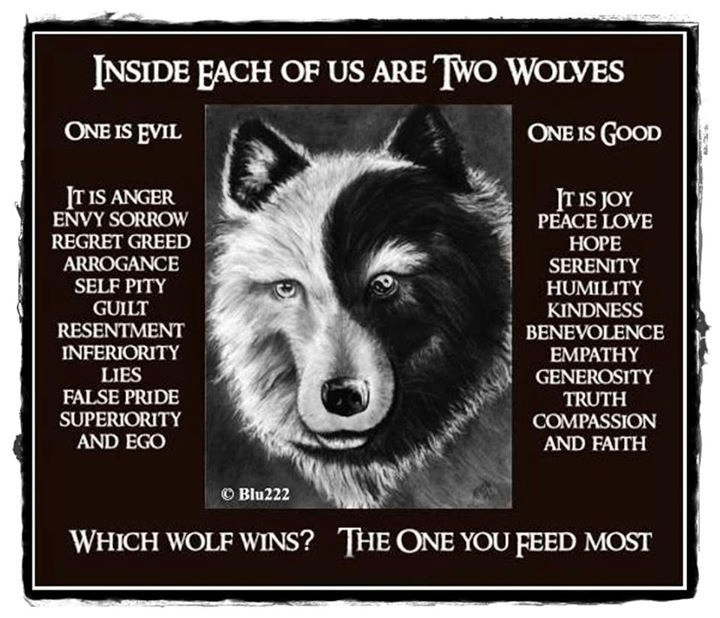
Feeding the right Wolf

This story has always resonated with me, but I saw it in action not too long ago. So, I wanted to share my insight.

It is an old Cherokee tale, and it is as follows:

We don’t realize how people around us can influence us. Again, small adaptations and changes over time are hardly noticeable. BUT when you surround yourself with good people who have good intentions, whether you know it or not, it starts to have an impact on your life. Somone very close to me who has always been a good person but wasn’t necessarily surrounded by the same caliber of individuals, married a very selfless man. They have been together for years now. Recently, I got to see the impact it had on her life. It truly amazed me how her thought processes, views, and behavior had changed. I instantly thought of the story of the wolf. She fed her good wolf, and it was a beautiful experience to endure! Be aware of your surroundings and if you have the choice, choose to surround yourself with altruistic people.

Featured

What is Neuroplasticity and why do I care?

Neuroplasticity is defined as “a process that involves adaptive structural and functional changes to the brain.” Another more specific definition is “the ability of the nervous system to change its activity in response to intrinsic and extrinsic stimuli by reorganizing its structure, functions or connections” (Puderbaugh & Emmady, 2022, para. 1).

Why should you care about this? Because it effects all of us. Have you ever driven a route so many times that when you get to your destination, you vaguely remember the drive? The first time you drove that route, you had to pay more attention because your brain wasn’t familiar with the roads, the patterns of traffic or the surrounding scenery. After numerous times of taking the same path at around the same time every day or very frequently, your brain starts to retain a pattern. In order to conserve energy, your brain creates a short cut because it has already experienced this drive so many times, therefore you do not have to think as much while you are driving. This is exactly what happens with our thought processes (including our internal chatter) in our brain. Science used to claim that we only used a certain percentage of our brain. According to the site, Human Brain Project (2017-2022) we don’t just use 10% of our brains. We use all of it through different times, even when we are sleeping. Check out this link: https://www.linkedin.com/company/human-brain-project/
Why is this important? We have the ability to change our brains. Is it easy? Hell no! Can you do it? Yes! Implementing small changes to your life can help you change your brain. That is why the talk about intentionally practicing gratitude (or what I like to say “positive neuroplasticty”) and why it is so important. I have no idea where this quote originated, but I hope it helps you to understand the why. “I don’t look at my glass as half full or half empty. I am just thankful I have a glass” (author unknown) Find the things in your life that pull on your heartstrings and make the effort to put them in your life, even if just for a minute, every single day.

Puderbaugh M, Emmady PD. Neuroplasticity. 2022 Feb 8. In: StatPearls [Internet]. Treasure Island (FL): StatPearls Publishing; 2022 Jan–. PMID: 32491743.

Human Brain Project. (2022, March 18). Human Brain Project. https://www.humanbrainproject.eu/en/follow-hbp/news/videos-of-understanding-consciousness-conference-now-available/?utm_source=linkedin&utm_medium=social&utm_campaign=brain_awareness_week_2022

Featured

A Challenge for the readers… If you are out there!

I am listening to an audio book called, “The Molecule of More” by Dr. Daniel Lieberman and Michael Long. It’s about Dopamine and how it affects our lives. One section explained (I am horribly paraphrasing) that we tend to release more dopamine in anticipating the task rather than actually doing the task. I am queen of this. I get really excited thinking about these great ideas and ways I can help others through what I have learned, but when it comes to actually getting it there, I really suck. I don’t even know why because I truly enjoy it. Maybe it’s the fear that no one will read anything and not care at all. BUT TODAY, I am trying! I just updated my “Resources” section to include some of the TED talks that helped me become mentally and physically better as a person. If you’re into TED talks and mental health, you’re welcome! If not, try a few and see if you like them. Thank you!

Helpful Resources

I feel like life is constantly learning. We should all never stop learning, no matter how far we have come. My goal with the blog portion of this site is to provide helpful resources to people who actually read it. The purpose of the posts on this site are things going on in my head that I need to get out there somehow (since I don’t have social media, nor do I want to). I do admire the individuals who are raw and vulnerable on their social media pages, though.
It is always intriguing to me what we know, what we don’t know, and the different types of intelligences in the world. If I can find a way to talk with people (without being a licensed professional) that helps them, then I am going to do it. For example, I was working with a professional football player who had retired and became very successful. His success and playing in the NFL did not protect him from mental diseases though. He definitely had TRD (treatment resistant depression) and no matter what he tried, nothing seemed to work long term. One night I got a call from a mutual friend that he was actively suicidal. My friend went to his house and to make sure he was safe. As I talked to him on the phone, he was hurt and angry that nothing had worked for him in the long run. I gently reminded him that his brain was reacting and operating like a business while his mind was more of a companion. I said, “You know how long it took for you to build your body the way it is, it didn’t happen overnight. This is how your brain operates as well. It is going to take time for you to feel better.” That really resonated with him, and he was very appreciative. With that being said, here is the resource for the day. I would like to introduce an amazing concept created by Johnny Crowder called Cope Notes for daily mental health support. Please check out his TED talk and website below. Remember it is these small daily habits that we implement into our lives that can help us in the long run!
https://www.ted.com/talks/johnny_crowder_how_to_grow_as_a_person_and_why_it_sucks

It’s going to take time and time is not on your side!

I was watching a movie on Netflix called, “Love Happens” about a man who lost his wife, but gives conferences about being “A-okay” when in actuality he has never mourned or gotten over the loss of his wife. As he was coaching and helping other individuals mourn the loss of their loved ones, he was able to come to terms with the fact that he needed to practice what he preached. I can’t tell you how many times I felt like this as I was trying to help other individuals get through their mental health struggles. We are all human and we all go through ups and downs of life. Some down times last longer than we would want them to. I don’t have all the answers, maybe some answers for a certain audience, but what I have learned is this: not being depressed, feeling anxious, or going through the symptoms of your PTSD takes time. A LOT OF TIME. It’s also not a linear function where everything just gets better and better. Yes, there are times when I feel on top of the world and actually happy, but then there are also times when I feel so low and don’t understand what all of this is for. I would hear so many people say, “I just don’t want to feel (insert whatever word you don’t want to feel anymore)!” The most common words were stressed, anxious, sad, unmotivated. Well unfortunately, we all have to feel those unpleasant feelings in our lives. Because without feeling the negative emotions, would you truly appreciate the positive ones? It’s like when you wake up from a bad dream and realize, it was just a dream. It’s such a relief. That is another reason why I love Susan David so much! Whenever her clients expressed how they didn’t want to feel negative emotions anymore, she would say, “You have dead peoples’ goals. Only dead people don’t feel anything!” I recently had a bad day that evoked my PTSD. And although I can put a smile on my face and do my best, my physiological symptoms are in an uproar inside of me. My stomach is sick. I feel ashamed of myself like I know it’s my fault again. I am waiting and watching for the person to do something to hurt me in some way whether it be with words or some passive aggressive stab. It was definitely a bad couple of days, but I got through it. The Monsters Within is really referring to the monsters that we feed inside of us. We all have them. Your struggles don’t have to turn you into a toxic person though. You can still love and surround yourself with love after all of the hell you have gotten through. And since I rave about her constantly, here is the TED talk from Susan David:
https://www.ted.com/talks/susan_david_the_gift_and_power_of_emotional_courage?language=en#t-879

How are you not on anything?

I took antidepressants, on and off, for 15 years. Do I still struggle with depression and anxiety? Yes, but now I feel like I have better tools on how to cope with it. Do I think it will ever go away? Maybe. I really don’t know though. It is cyclical for me. One of the most common questions I get from patients is, “How did you come off of your antidepressants?” There was no single variable or event that helped me come off of the drugs. I titrated off slowly with my doctor’s recommendations. Then I started working out almost every single day releasing the endorphins I needed at the time and losing almost 40 lbs, gaining confidence in myself. Next, I was in an extremely abusive and controlling relationship (which later I would realize was probably the best blessing in my life!) During this time, I learned how to use parts of my brain that I had rarely used before. I started working with my hands (and there is some research that supports working with your hands, like knitting, or in my case making monsters, is actually therapeutic and was once prescribed to help ease anxiety). What I had learned during this difficult time was how much a human could actually change. I watched myself become a completely different person. After I had finally left, I realized if I could change during that time, I must be able to change again, but be stronger and definitely a bit more wise! Adversity leads to strength. However, here is the thing. I started practicing gratitude before I even knew what it was. I had lost everything. I left that situation with absolutely nothing (because I had to for safety reasons). It sucked… really bad. I was embarrassed and ashamed of myself at 34 with all this education and nothing to show for it. Nothing. BUT it was the best thing that EVER happened to me. I started appreciating EVERYTHING. Every single smile from a stranger, talking to random people everywhere, a text from my friend, having time to myself, being able to talk to my mother for more than 15 minutes without feeling pressured. It was literally almost everything. My friends would laugh because I was the “yes” girl and lived as much as I could with them. I felt like I finally knew what happiness was. I know there is no one size fits all treatment and something that worked for me, may not work for someone else. What do you have to lose though? What you have tried so far isn’t working; if some of what I am saying resonates with you. You can’t continue to behave in the same ways, going through the same things over and over again, and expect a different result! With that being said, here is a fun TED recommendation to break you into gratitude. (or how we like to call it, Positive Neuroplasticity)